
INDEX
How Companies Can "Accelerate" Human Rights in Times of Crisis and Transformation
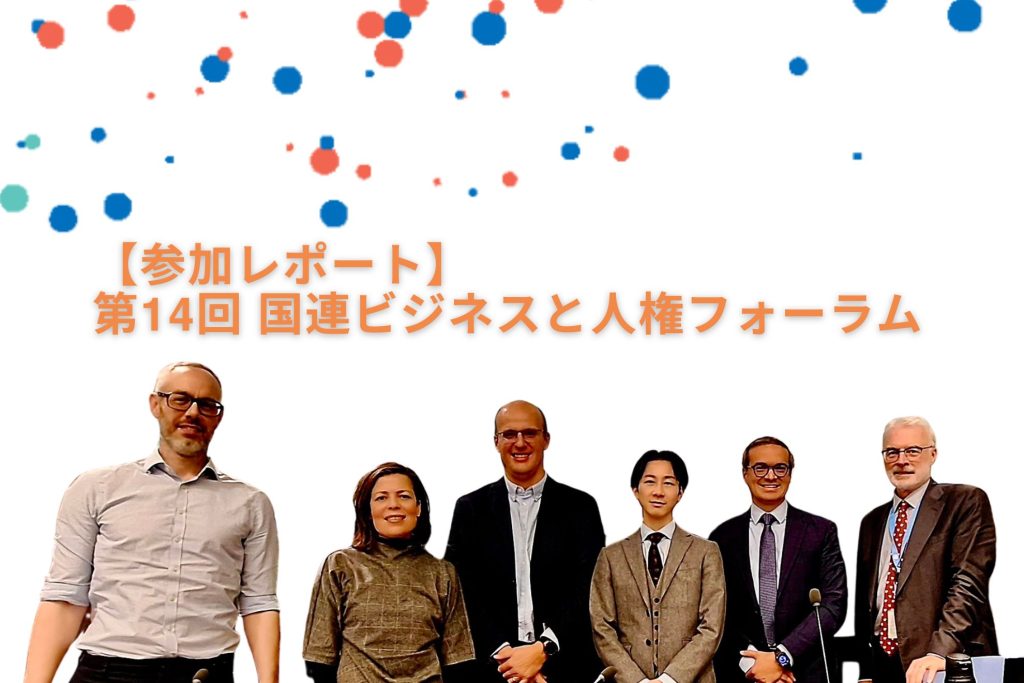
On November 24-26, 2025, at the 14th UN Forum on Business and Human Rights, held at the European Headquarters of the United Nations in Geneva (Palais des Nations),A record number of 4,650From aiESG, Sakai, Business Director and General Manager of the Corporate Planning Office, attended the event, including a presentation at the Human Rights Due Diligence in Small and Medium-sized Enterprises (SMEs) in Challenging Times. Human Rights Due Diligence in Small and Medium-sized Enterprises (SMEs) in Challenging Times.
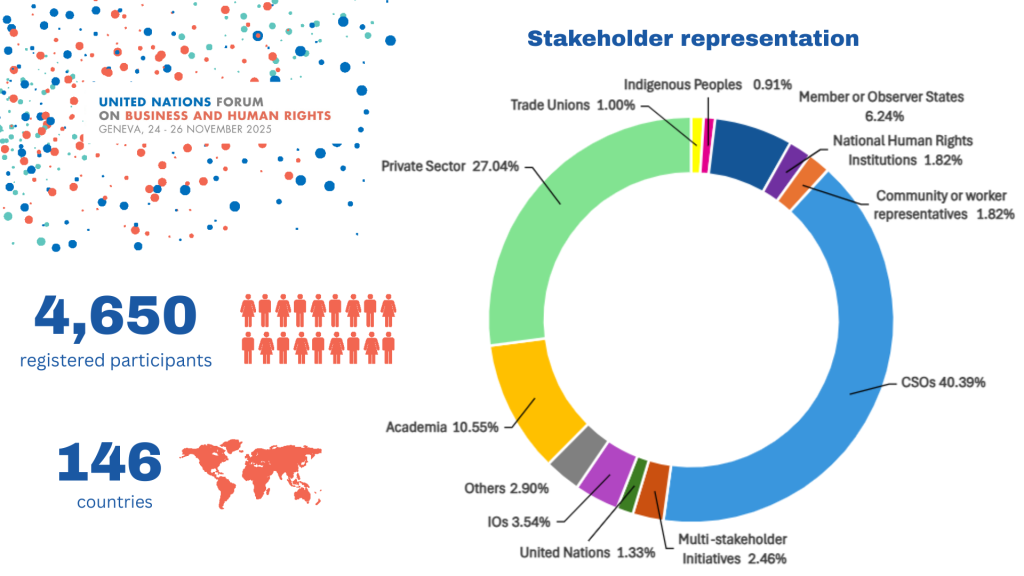
The theme of this forum is.
"Accelerating action on business and human rights amidst crises and transformations"
(Accelerating Business and Human Rights Action in Crisis and Transformation)The following is a list of the most common problems with the "C" in the "C" column.
Geopolitical risks, climate change crisis, rapid technological innovation, widening disparities, and increasingly complex global supply chains. In the so-called "polycrisis," this forum was a forum for companies to question how to maintain and strengthen their responsibility to protect and respect human rights.
In this report article, based on discussions at the UN and in the participating countries, the "five insights" of particular importance to Japanese corporate practitioners and,7 actions you can start tomorrowwill organize the event. Also speaking at a session in the forum is Japan's first AI-based human rights due diligence solution, and aiESGThis section will also include insights as
■Insight 1|Accelerate because of the crisis, not stop because of the crisis
At the Forum's opening ceremony, the UN Working Group on Business and Human Rights delivered a clear message.
Human rights responsibilities are not suspended just because the world is in crisis."
In each country,
- EU CSDDD(*1) lost
- Anti-DEI Activities in the U.S.
- Conflicts and coups hitting the supply chain
The presence of "headwinds" was shared.
The overall message, however, was not pessimistic. Rather,UNGPs (Guiding Principles on Business and Human Rights) as the "North Star" and accelerate action in times of crisis.The prevailing tone was "I'm sorry, I don't know.
▶ Implications for companies
- Don't go into a "wait and see" mode just to see the instability of regulations and political trends.
- Redefining priority human rights issues in times of crisis, based on the UNGPs and our own policies
- It is too late to "do it in peacetime." Recognize that the crisis is amplifying human rights risks right now, and act ahead of time.
(*1) Corporate Sustainability Due Diligence Directive
EU legislation requiring companies to conduct "due diligence" to identify, prevent, and mitigate negative impacts on human rights and the environment in their own companies and supply chains will enter into force in July 2024, with phased application beginning in 2027.
The purpose of due diligence is not "risk detection" but "behavior change.
A common thread that ran through several sessions was the nature of human rights due diligence ("HRDD").
The goal is not to detect risks, but to prevent adverse effects on people and society and to respond when they occur. The goal is to prevent adverse effects on people and society, and to respond when adverse effects do occur."
On the other hand, concerns were expressed that the CSDDD would be limited to Tier 1,"Beyond Tier 1". was a major theme.
■aiESG Speaker Session: "Practical Solutions" to Advance HRDD
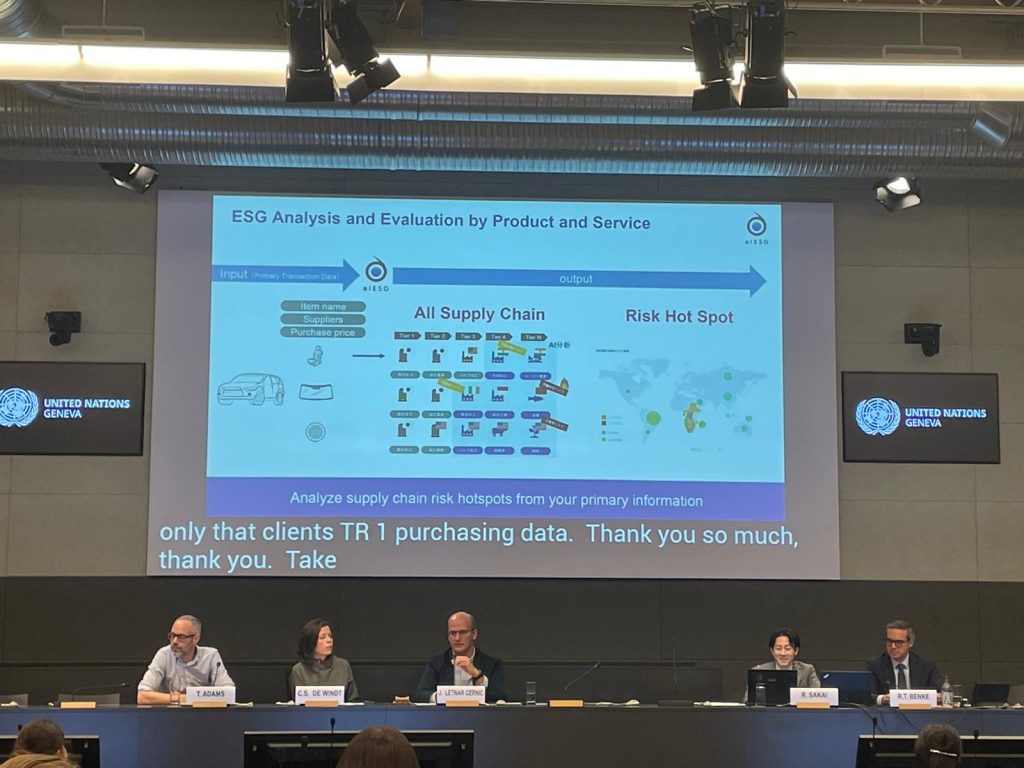
Session on "Human Rights Due Diligence in Small and Medium-sized Enterprises (SMEs) in Challenging TimesThen,Ryosuke Sakai, General Manager, Corporate Planning Office, aiESGwas the speaker and is also available on UN Web TV.
https://webtv.un.org/en/asset/k1i/k1i0efjjfd

The key points of the session are as follows
1) HRDD can be started without perfect visibility.
A common concern for many companies
- I can't see beyond Tier 1.
- Cannot grasp down to the raw material level
- Stay with Tier 1 suppliers until data is available
As a result, many companies remain limited to managing Tier 1 suppliers.
2) "Jump-starting Visualization" with aiESG
aiESG accelerates corporate HRDD with the following approaches
- Multilateral Input-Output (MRIO) x AI
→ Estimate where in the world raw materials are coming from based on Tier 1 purchasing data - Mapping ESG risks by country x industry x process from over 400 publicly available reports
→ Immediate identification of "where are the risk hot spots". - Provide "priority supply chain" direction in a short period of time
(iii) People can concentrate on "work that only people can do.
By streamlining the time spent on visualization with AI and quantitative analysis,
- Hear the voices of workers and local communities
- Build trusting relationships
- Understanding context and making ethical decisions
and can devote resources to the essential tasks that people should be responsible for.
Result: HRDD has moved from a "search process" to a "process of action.
This is,Direct resources to support rights holders who are truly sufferingEnables highly effective HRDD.
■Insight 3|Climate, Biodiversity, Migration, and Health: Environmental Risks are Human Rights Risks
Climate change, water resource risks, and biodiversity loss, through migration, health hazards, and poor working conditionsDirect human rights riskswill be.
But in many companies,
- Climate-related data
- Human Rights Data
are currently managed separately.
Forum,Companies should accelerate their efforts to assess the environment, climate, and human rights in an integrated manner." A strong message was shared.
aiESG, but through integrated modeling of ESG risks,Analysis to visualize the relationship between "environmental issues and human rights risks" in an integrated mannerWe provide the following services.
■Insight 4|What to rely on in a world that is heavily influenced by the political situation
This year's forum shared a greater sense of political instability than in previous years.
- Claims by Chinese government representatives
- Policy retreat on ESG and DEI in the U.S.
- Omnibus" and Stagnation of CSDDD in the EU
This is a situation where political developments directly affect human rights and sustainability regulations.
What was repeated in the process was,
The legal systems of countries may waver, but the UNGPs do not."
Companies,
- Set your company's "minimum" in the UNGPs
- Treat laws and regulations as something to be built on top of.
The point was the need to clarify the attitude that
■Insight 5|Specifying "Whose Human Rights Are We Protecting?": Indigenous Peoples, Migrant Workers, and Human Rights Defenders
The voices of indigenous peoples, women and children, migrant workers, and Human Rights Defenders (HRDs) were featured throughout the forum. In particular, speakers at the "Just Transition" sessionPanelists as young as 16 years oldleft a strong impression.
▶ Implications for companies
- No "abstraction" of rights holders
- Specific assessment of business impact, focusing on the vulnerability of specific populations
- Dialogue with domestic rights holders (foreign workers, people with disabilities, local communities, etc.) is also essential
■Seven Actions Japanese Companies Can Take Starting Tomorrow
- Reaffirm UNGPs as "your constitution", not regulations
Perform a gap analysis with existing policies. - Concentrated investment in the "most significant risks."
Priorities are determined by the impact on people, not by the volume of data. - Redesign of Grievance Mechanisms
Review the point of contact, language, anonymity, and follow-up system from the whistleblower's perspective. - Decide on one pilot case for "Beyond Tier 1".
Selecting high-risk countries and commodities, and trying out initiatives in collaboration with NGOs, governments, and other companies. - Begin dialogue with domestic rights holders
Consider holding a roundtable with stakeholders. - Provide human rights briefings to the Board of Directors
Share international trends and the company's materiality to the board members, even if it is only once a year. - Join a trusted network
Industry associations, UN Global Compact, Multi-Stakeholder Initiative (MSI), and other "one company can't do it all" issues.
■Conclusion: In Times of Crisis, Put Human Rights at the Heart of Business
The message that was being sent throughout the forum was consistent.
In times of crisis and transformation, putting human rights at the center of business supports corporate sustainability."
The aiESG is a company'sA practical mechanism to "accelerate" human rights due diligence in a complex and turbulent worldWe provide the following services.
Whether you need to visualize your supply chain, conduct an integrated assessment of environmental and human rights risks, or identify priority actions, we look forward to working with you as needed.
https://aiesg.co.jp/