

INDEX
(Head office: Fukuoka City, Fukuoka Prefecture; Representative Director: Shunsuke Managi; hereafter "aiESG") participated in a renewable energy auction organized by the Japan Power Exchange (JPX) and won the bid for 60,000 kWh of Non-Fossil Certificates (NFCs). The successful bidder will be able to use 2025 kWh of NFCs (Non-Fossil Certificates). We are pleased to report that the purchase of the NFCs will make us virtually carbon-free in terms of greenhouse gas emissions (Scope 2) associated with electricity use in our business activities in fiscal 2025 (April 2025 to March 2026), while also taking into consideration the human rights risks in the related supply chain.
For more information on bidding information, please contactthis way (direction close to the speaker or towards the speaker)
This initiative is an expression of aiESG's strong commitment to promote decarbonization in a credible and science-based manner, as reported in our Sustainability Report compliant with the framework of the Task Force on Nature-related Financial Disclosures (TNFD), which was already published on July 22, 2012.
Why Renewable Energy Certificates Now?
In recent years, many companies have engaged in carbon offsetting through the use of "carbon credits". While offsetting is seen as a useful means of storing decarbonization in future climate action,SBTi (Science Based Targets initiative)and other international initiatives have not positioned it as a primary means of short-term emission reduction targets . In fact, beside the realization of carbon offsets, some projects have been pointed out to be associated with human rights violations . When utilizing offsets, aiESG believes that it is important to carefully select and ensure the transparency of credits while prioritizing substantial emission reductions first.
Deeply concerned about this situation, aiESG has sought to contribute to decarbonization in a way that guarantees transparency and credibility. As a result, we have decided that the most reliable way to contribute is through the use of "renewable energy certificates (non-fossil certificates)," which, unlike conventional carbon credits, are also recognized by SBTi and provide measurable and traceable proof of renewable energy generation.
Difference between renewable energy certificates and carbon credits
Renewable Energy Certificates (NFCs/RECs):
- Definition: A certificate that certifies that the electricity used by a company comes from renewable energy sources. 1 MWh (kWh in Japan) of renewable energy is issued for each MWh of renewable energy generated and supplied to the grid.
- Objective: Focus on electricity consumption (Scope 2) and encourage investment in renewable energy generators.
- Reliability: Power generation is clearly measured and tracked and recognized by major sustainability reporting standards such as SBTi.
Conventional carbon credits:
- Definition: Credits that certify investments in carbon dioxide removal from the atmosphere or avoided emissions, such as afforestation and forest conservation, and are often used by companies to offset a portion of their Scope 1-3 emissions.
- Issue: It has a number of problems, such as the alleged lack of actual emission reductions and its linkage to human rights issues; it is not positioned in SBTi as a primary means of corporate emission reduction targets.
To fulfill our responsibility to the future
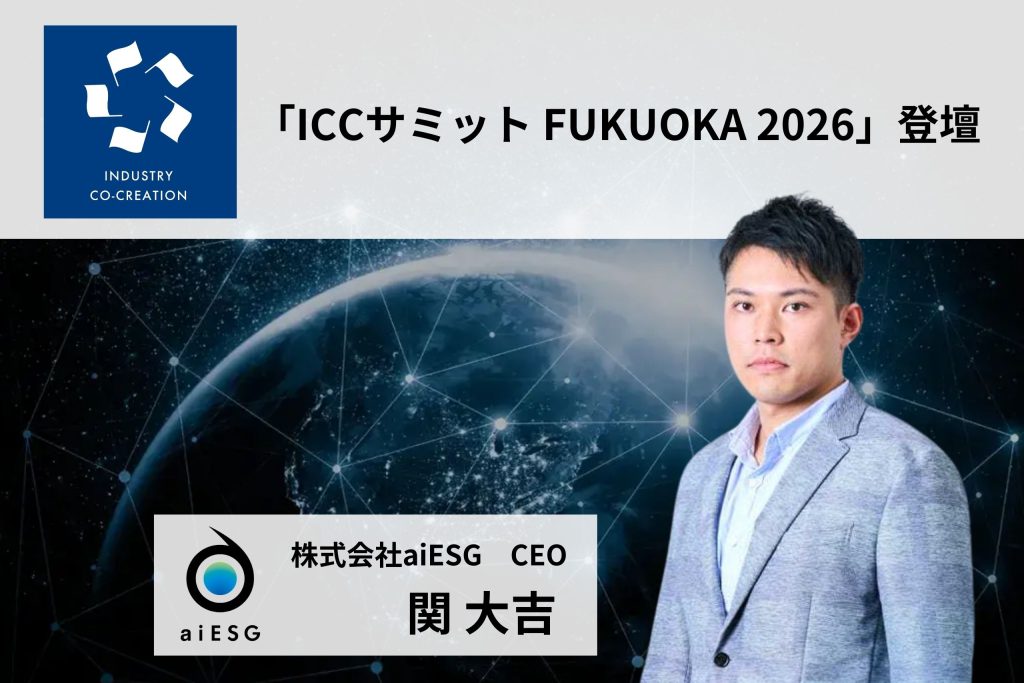
Comments from Daikichi Seki, CEO, aiESG
As a company with sustainability at the core of our business, we at aiESG believe that it is important to take actions that are substantive and scientifically based, not those that are just for show. This purchase of non-fossil certificates is a concrete first step based on this belief. We hereby declare that we will continue to contribute to the realization of a decarbonized society in a transparent manner by conducting thorough and reliable due diligence.
aiESG will continue to strive to reduce the environmental impact of its business activities and contribute to improving the sustainability of society as a whole as a leading company in the field of ESG.
About aiESG
aiESG is a start-up company from Kyushu University that aims to realize a sustainable society through product and service level ESG analysis. Based on the results of many years of international and academic ESG research, including UN report representatives, we provide an ESG assessment platform called "aiESG Flow" that traces back the entire supply chain. We also provide support services on all aspects of ESG.
Click here to visit our corporate website https://aiesg.co.jp/)
Company Profile
Company name: aiESG Inc.
Head Office: NMF Hakata Ekimae Bldg. 2F, 1-15-20 Hakata Ekimae, Hakata-ku, Fukuoka City, Fukuoka
President and Representative Director : Shunsuke Managi
Business : ESG analysis business at the product/service level
HP :https://aiesg.co.jp/
Establishment : July 2022
For inquiries regarding this matter, please contact: aiESG Public Relations, Inc.
e-mail: (English) pr@aiesg.co.jp