
INDEX
Introduction.
In recent years, addressing "human rights risks" in companies has become an important management issue. This is due to the Guiding Principles on Business and Human Rights (UNGPs) adopted by the United Nations in 2011, which require companies to prevent and correct human rights violations through their own business activities.
In response to these trends, calculation methods that enable companies to "visualize" and appropriately manage human rights risks are attracting attention.
This article describes aiESG's methodology for quantifying human rights risks and how the results can be useful for corporate activities.
What are Human Rights Risks?
Human rights risk refers to "situations that may occur in relation to a company's business activities and its value chain, and that have the potential to violate human rights.
Such risks include, for example, forced labor and child labor, payment of sub-minimum wages, harsh working conditions, discrimination and harassment, and violation of local community rights.
The human rights risks to be considered in a company's business activities and value chain are based on international guidelines and consensus documents such as the UN Universal Declaration of Human Rights and ILO Conventions, and the guidelines for Social Life Cycle Assessment (S-LCA) [1]. and are organized as follows (Figure 1).
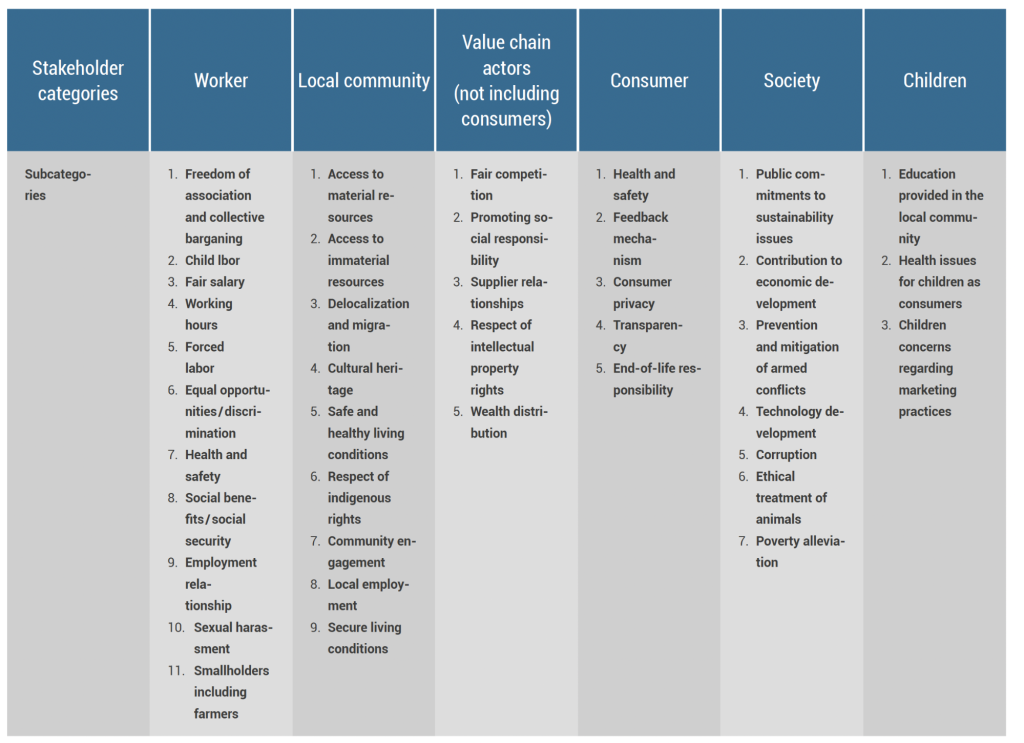
[1] unep. (2020). Guidelines for Social Life Cycle Assessment of Products and Organizations 2020. United Nations Environment Programme.
https://www.lifecycleinitiative.org/library/guidelines-for-social-life-cycle-assessment-of-products-and-organisations-2020/
S-LCA is a framework used to assess the social impacts associated with a product or service throughout its life cycle, including all stages from raw material extraction, manufacturing, distribution, use, and disposal or recycling.
aiESGMethods of human rights risk quantification in
Based on the international guidelines for S-LCA described above, aiESG utilizes social big data based on research conducted by the Manaki Laboratory of Kyushu University and supplements it with AI-based industry average data to enable comprehensive estimates of the social impact of a product's manufacturing, accumulated up to the very top of the supply chain. This enables comprehensive estimates of the social impact of a product's manufacturing up to the very top of the supply chain.
In this estimation, human rights risks are quantified as "Risk Hours. Risk working hours are defined as "Total estimated risk hours of labor involved in the production of a given product, where labor is estimated to be performed in an environment at risk of human rights violations.Represents a "-".
The reason why human rights risks are expressed in units of "working hours" is that working hours are a useful indicator for understanding the distribution and scale of economic activities in a supply chain. Processes with a large number of working hours are likely to involve that many people, and if a human rights risk exists, its impact could be far-reaching. Therefore, working hours are used as an indicator of the potential scale and severity of human rights risks and to assess and identify priority areas for response in the supply chain.
To calculate risk working hours, aiESG uses the Reference Scale Approach, one of the S-LCA methodologies, to quantitatively assess human rights impacts.
The criteria scale approach quantitatively expresses social performance, such as human rights and labor, by comparing it to international standards and rating the magnitude of risk in terms of a stepwise score.
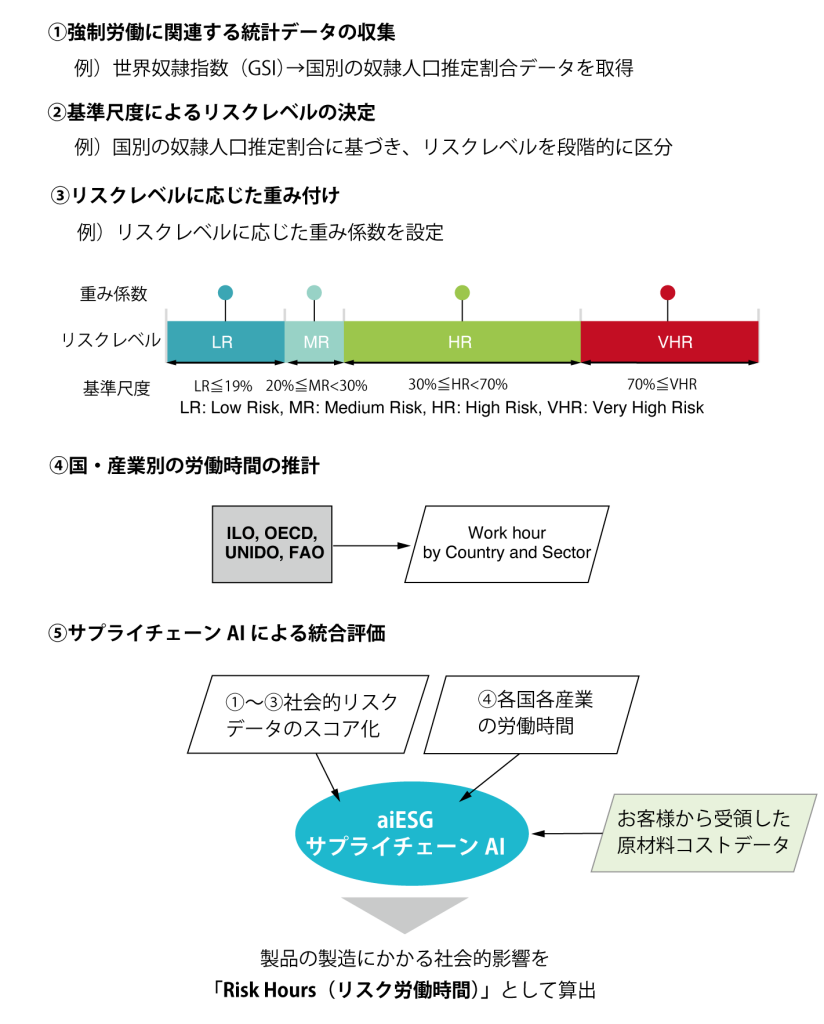
Based on the reference scale methodology, risk labor hours are calculated using the following procedure. As an example, here is the procedure for calculating the risk labor hours for forced labor for a given product.
(i)Collection of statistical data related to human rights risks
Collect reliable statistics (e.g., ILO, State Department, NGO databases, etc.) for each country and each industry on forced labor.
(2)Determination of risk level by reference scale
Based on the information collected, risk levels for each country and industry are classified into four levels: very high risk (VHR), high risk (HR), medium risk (MR), and low risk (LR).
(iii)Weighting according to risk level
Set weights for each of the above risk levels and score the impact according to the magnitude of the risk.
4)Estimated working hours by country and industry
We estimate labor hours by country and industry involved in the manufacture of the product using hourly wage rate data from the International Labor Organization (ILO), the United Nations Industrial Development Organization (UNIDO), the Organization for International Cooperation and Development (OECD), and the Food and Agriculture Organization of the United Nations (FAO).
5)Integrated Assessment with Supply Chain AI
We integrate the human rights risk data and working hour information obtained in (1) through (4) above into our proprietary AI-based supply chain analysis model. This enables us to trace the entire supply chain for each product based on raw materials and process data received from our customers, and quantitatively calculate the distribution and impact of human rights risks (e.g., forced labor, child labor, etc.) associated with product manufacturing in the form of "risk labor hours".The following is a list of the most common problems with the "C" in the "C" column.
Interpretation of results and usefulness of utilization
Although the calculation of human rights risk does not determine the actual occurrence of human rights violations, it is an effective means of quantitatively understanding and comparing the location and magnitude of potential risks in the supply chain.
This "visualization" of risk allows companies to identify risks in the supply chain thatClarify priority areas to be addressed and make decisions to take appropriate measurescan be obtained.
In particular, aiESG's model can visualize human rights and social risks such as forced labor and child labor in the manufacture of products, going back to the very top of the supply chain by utilizing vast amounts of statistical and social data and reconstructing the entire supply chain using AI.
It is also consistent with international guidelines and can be used as a basis for corporate non-financial strategies such as human capital management and ESG disclosure.
By transforming invisible risks into "visible criteria," it clarifies issues that companies should prioritize and encourages more ethical and transparent corporate management.
summary
Human rights risk is an important topic that significantly affects corporate transparency and credibility.
aiESG Inc. provides services aimed at building a sustainable society by visualizing social issues latent in corporate activities through data and AI. Please feel free to contact us.
About aIESG's services:https://aiesg.co.jp/service/