
INDEX
Corporate value has moved beyond being measured solely by financial indicators to also take into account factors such as responses to diverse social issues and results. ESG (Environment, Social, Governance) initiatives are becoming indispensable for companies to achieve sustainable growth. ESG analysis not only "visualizes" a company's potential non-financial risks (NFR), but is also attracting attention as an indicator that directly relates to long-term competitiveness and cost of capital.
Clients

Company name: Tokyu Land Corporation
Business activities: General real estate business
HP:https://www.tokyu-land.co.jp/
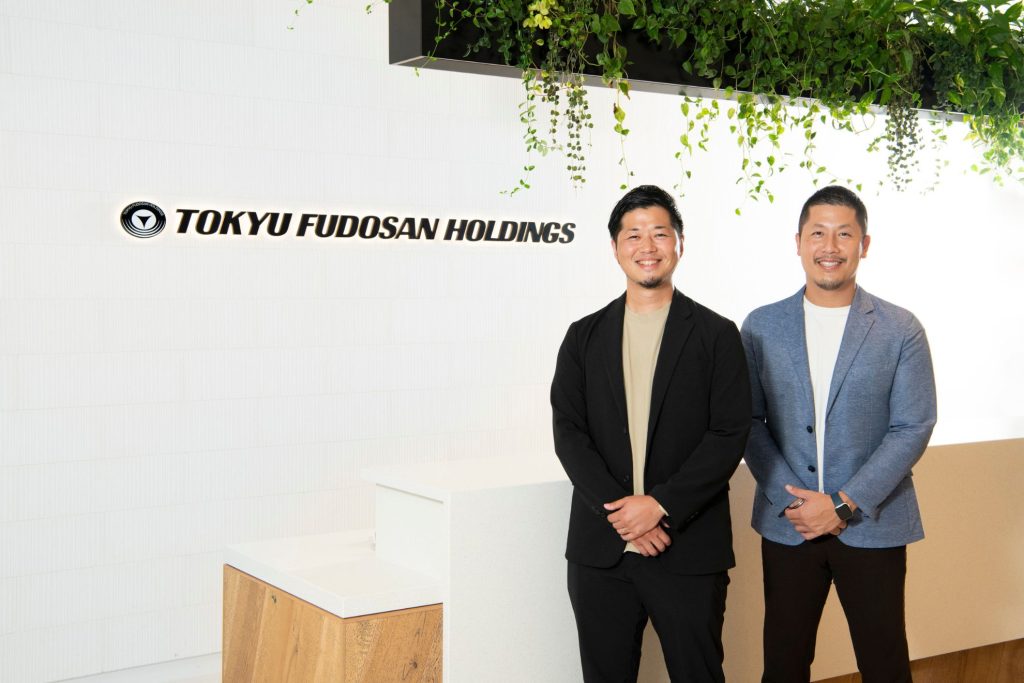
Tokyu Land Corporation is an environmentally friendly company that continues to take on the challenge of solving social issues through urban, residential, and infrastructure projects under the slogan of "sustainable urban development. Its latest attempt is "Green Cross Park," a nationwide industrial community development project. As part of this project, "Southern Tosu Cross Park," a large-scale industrial park development project in Tosu City, Saga Prefecture, incorporates renewable energy and next-generation logistics, and has introduced ESG analysis using aiESG's "New Wealth Index (IWI)" (*). By comprehensively evaluating the environment, society, and human resources, we have identified values that contribute to the region and its future.
In this article, we interviewed Mr. Wataru Okubo and Mr. Shoji Shimada of the Industry Business Division, Infrastructure & Industry Business Unit, Tokyu Land Corporation, about the background to the introduction of ESG analysis, the results obtained, and future prospects.
(*) The New Wealth Index (IWI) is an index adopted by the United Nations that measures the wealth of a country or city in terms of "man-made capital," "natural capital," and "human capital. In Japan, aiESG's representative, Dr. Managi (Senior Professor at Kyushu University), is a leading expert in this research area.
Tokyu Land Corporation on ESG Initiatives and the Role of the Infrastructure & Industry Business Unit
--What is your company's overall business and what role does the infrastructure and industry business play in it?
We are engaged in a wide range of businesses, including "Urban Business," "Housing Business," "Infrastructure & Industry Business," "Wellness Business," and "Overseas Business. Among these, the Infrastructure & Industry Business is responsible for building the infrastructure that supports society, with a mission of "solving Japan's social issues," including logistics facilities, renewable energy, and data centers.
Specifically, in the renewable energy field, we have been contributing to the realization of a decarbonized society by developing solar and wind power generation throughout Japan. In the field of logistics facility development, we have not only developed and improved infrastructure to meet various demands arising from the expansion of e-commerce, but also worked on "creating facilities that are easy to work in" to address social issues such as driver shortages. We believe that these projects are the very practice of "sustainable urban development" that we stand for.
In addition, in order to generate synergies across our diverse business areas, the Infrastructure & Industry Unit is working together to develop large-scale urban development projects.
Southern Tosu Cross Park Project "Next Generation Industrial Complex" in its entirety
--Could you please introduce this "Saga Tosu Project"?
Tosu City in Saga Prefecture is highly advantageous as a transportation node in Kyushu, and is an important base for supporting logistics and manufacturing throughout Japan. Tosu City has a very favorable location, with low seismic risk and an abundance of water and labor resources. On the other hand, in recent years, local issues such as a shortage of industrial land have become apparent.
We are working with Saga Prefecture, Tosu City, and Kyushu University in an industry-academia-government-private partnership to develop an industrial park. In addition to attracting companies, mainly in the manufacturing industry, we are developing facilities that can be used by local residents and planning measures to promote sports and other activities. The goal is to improve the vitality of the entire region and create a sustainable future.
What makes it unique is that it aims to be a "next-generation industrial park" incorporating GX (Green Transformation) and DX (Digital Transformation) elements such as the realization of 100% renewable energy and support for self-driving trucks.
ESG analysis, the need to "quantify social value
--What challenges did you face in the project that led you to introduce our ESG analysis?
In pursuing the project, we faced challenges in each aspect of ESG.
The environmental (E) aspect involved the impact of landscaping and infrastructure development on the landscape and ecosystems, the social (S) aspect involved coexistence with local residents and job creation, and the governance (G) aspect involved long-term risk management and consensus building with various stakeholders.
Against this background, we strongly felt the need to quantitatively demonstrate to landowners and local governments "what kind of social value the project would bring. Through our collaboration with Kyushu University, we learned about the "New National Wealth Index" recommended by Professor Manaki, who is also the head of aiESG. We decided to introduce the index because we found its great significance in its ability to visualize not only economic spillover effects but also "artificial capital, human capital, and natural capital (new national wealth)" in an integrated manner.
Impact of the New National Wealth Index
--Please tell us about the specific analysis process and the results that impressed you.
We provided basic data such as the current land use plan, anticipated scale of construction, and number of employees. Since the project was still in the conceptual stage, many of the calculations were based on assumed values.
As a result, we found that a very large increase in "new national wealth" of approximately 30 trillion yen was expected. The results of the evaluation included not only economic effects but also human resources and the natural environment, and we were honestly surprised at the scale of the project, which was much larger than we had expected.
However, while man-made and human capital are growing, a trend of declining natural capital has also become apparent. The results of this analysis have revealed issues that we need to address, and have reaffirmed the need for measures to supplement natural capital, such as the greening of entire towns and innovations in renewable energy.

--How are the results of your analysis utilized?
First of all, we announced it in a press release for the Saga Tosu Project. We believe this is very effective as a material to quantitatively show "social value" to landowners and local governments.
Even within our own group, some people have voiced the idea that it could be used for other projects as well. While we are careful not to let the numbers get too big and stand alone, there is a growing realization that they can be a weapon to explain the significance of our business.
For a Sustainable Future
--What are your future plans?
In the future, not only for the Saga Tosu project but also for other development projects, we intend to promote the introduction of 100% renewable energy as well as thorough greening and environmentally friendly construction to supplement natural capital. Furthermore, we intend to promote sustainable urban development through the employment of local human resources and the use of digital technology.
Based on the results of this study, we are also considering introducing similar analysis for development projects underway in other regions of Japan. we felt that ESG analysis is not merely a social contribution, but an essential element for both business promotion and enhancement of corporate value.
--aiESGWhat are your expectations for the "Mere Old Man" and what is your message to our readers?
We hope that aiESG will continue to provide us with multifaceted evaluations and new perspectives based on scientific and objective data analysis. We also hope that aiESG will utilize the knowledge it has accumulated to date to provide more concrete advice and support on the measures needed to support sustainable growth.
We are committed to creating a sustainable society and building the future of our region. We appreciate your understanding and support for the Saga Tosu Project and our efforts in other regions.
--Thank you very much for your time today, and we will continue to research and develop ESG analysis and new national wealth indices so that they become a strategic tool for companies to enhance their competitiveness for the future as well as a means for them to fulfill their "accountability".