
INDEX
Introduction.
This article is a commentary on the paper "Beyond carbon: Environmental and social impacts of Japan's vehicle electrification transition," co-authored by Keeley Alexander Ryota, Chief Researcher at aiESG, and Shunsuke Managi, President of aiESG. Beyond carbon: Environmental and social impacts of Japan's vehicle electrification transition.
This article provides an easy-to-understand explanation of the research and the services provided by aiESG. those interested in ESG data analysis and strategy development are encouraged to read to the end.
Title of paper: Beyond carbon: Environmental and social impacts of Japan's vehicle electrification transition
DOI (paper link):https://doi.org/10.1016/j.jenvman.2025.125509
Research Points/Summary
This paper provides an explanation based on a study that investigated the environmental and social impacts of the spread of electric vehicles (EVs) in Japan. While there have been many studies focusing on the environmental aspects of EVs, this study is unique in that it also focuses on social issues such as the labor environment and human rights violations during the manufacturing and supply stages of EVs.
As a result, it was found that although the increase in EVs reduces emissions from driving, it increases the environmental impact of power generation and battery manufacturing processes. As for social impacts, it was found that social problems are widespread, especially in Asian countries and Africa.
Background and Objectives
As a countermeasure against global warming, countries around the world are converting from gasoline-powered vehicles to EVs. In Japan, the spread of next-generation vehicles, including EVs and hybrids, is accelerating.
However, the widespread use of EVs is also causing new challenges. In some African and Asian countries, the mining of metals needed to produce EV batteries is conducted under poor working conditions and with insufficient respect for human rights.
Against this backdrop, this study analyzes the environmental and social impacts of projected changes in the Japanese automobile market from 2020 to 2050. It also examines how factors such as the evolution of EV technology and the extension of battery life will impact these burdens.
analysis
In this study, we constructed a model to forecast changes in the number of automobiles owned and the composition of vehicle types in Japan. The following three scenarios for EV diffusion by 2050 were then set up and analyzed.
- Status quo scenario:. Case for continuation of current EV penetration trend
- Rapid Diffusion Scenario:. The case for rapid EV diffusion
- Gasoline vehicle 0 scenario:. The case for banning the sale of new gasoline-powered vehicles in 2035
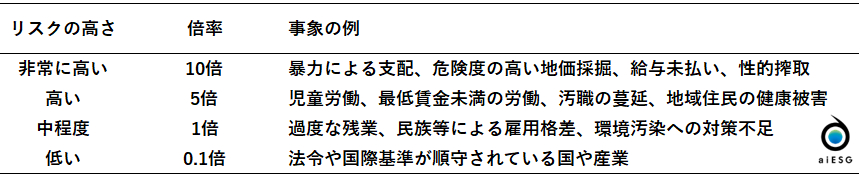
In evaluating environmental impacts, CO₂ emissions and resource consumption were converted into monetary values and compared. Social impacts were quantitatively evaluated using an index called "risk time (mrheq)," which is a multiplication of "working hours" and "social risk.
Table 1 classifies the risk of each event based on moderate risk.
result
While the widespread use of EVs has reduced emissions of exhaust gases when driving, it has become clear that they create new environmental burdens associated with energy consumption in power generation and manufacturing processes. Particularly in Japan, where a high percentage of thermal power generation is used, it is suggested that electricity itself, which is the power source of EVs, may have a negative impact on the environment.
In addition, while environmental impacts were mainly confined to Japan, social impacts tended to be concentrated overseas. Specifically, the study showed that in China, Asian countries, and Africa, there are many cases of people working in hazardous working environments at raw material extraction sites and battery manufacturing plants. On the other hand, it was also suggested that extending the service life of batteries and vehicles may contribute to reducing the overall environmental and social impact.
The figure below visualizes the annual social burden of all automobiles in Japan.
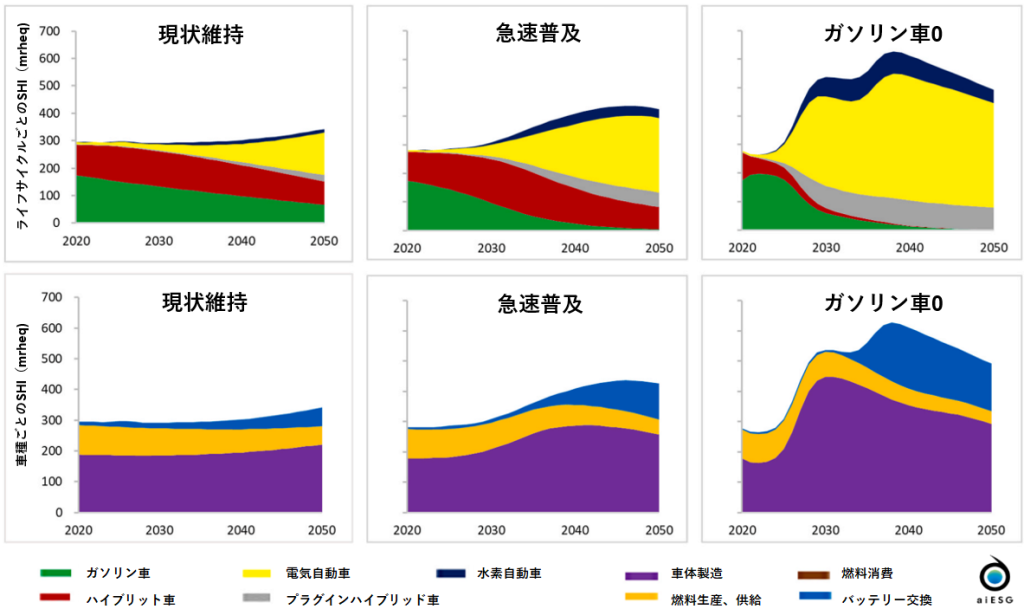
The SHI (billion mrheq) on the vertical axis indicates the time at risk when the medium risk is 1.
The social risk of electric vehicles is high, accounting for a large portion of the overall SHI, with the burden in the production phase significantly exceeding that of the use phase.
In the gasoline vehicle 0 scenario, the time at risk in 2050 is expected to be 490 billion mrheq and peak in 2037 at 642.4 billion mrheq. The main reason for the peak in 2037 will be the rapid increase in battery demand due to the rapid transition to next-generation vehicles.
consideration
The results of this study suggest that while the widespread use of EVs reduces the environmental impact of driving, the environmental and social impacts may increase significantly when the entire vehicle life cycle (from manufacturing to disposal) is considered. As an impact by vehicle type, the study showed that hybrid vehicles, which combine a gasoline engine and an electric motor, tend to have a better balance between environmental and social burdens than EVs and hydrogen vehicles.
Complementary measures such as extending the service life of batteries and automobiles, establishing a recycling system for parts, and increasing the ratio of power generated from renewable energy sources are essential for the future. Comprehensive assessment of environmental and social impacts throughout the supply chain, starting from the manufacturing stage, is required, and measures must be taken.
summary
aiESG Inc. provides a wide range of support, from organizing ESG indicators to providing specific assistance for each company. please feel free to contact us if you have any problems with ESG-related information disclosure or practices.
About aIESG's services:https://aiesg.co.jp/service/