
INDEX
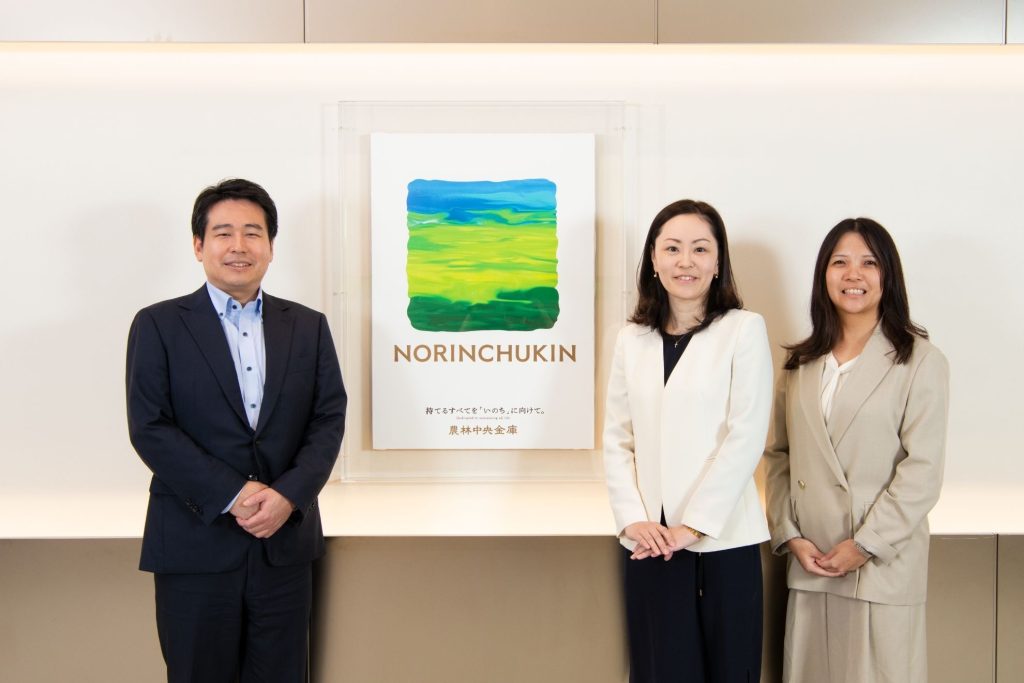
On July 31, 2025, aiESG, Inc. invited Ms. Saori Takahashi, Research Officer, Sustainable Management Group, Corporate Planning Department, The Norinchukin Bank, as a guest speaker for the webinar, "What ESG Management should companies undertake from now on? 〜The webinar, "What ESG Management Companies Should Do in the Future - The First Step of TNFD Learning from The Norinchukin Bank's Advanced Case Study -," was held. In this webinar, Ms. Takahashi explained the specific approach to TNFD (Task Force on Nature-related Financial Disclosure), which has become an urgent issue mainly for listed companies, and the strategy to link ESG management to corporate value enhancement, using an advanced case study of The Norinchukin Bank.
<Speaker Information
Saori Takahashi (Research Officer, Sustainable Management Group, Corporate Planning Department, The Norinchukin Bank)
After graduating from Keio University with a B.A. in Political Science and a M.A. in Sociology from American University in Washington, D.C., he joined the Japan Research Institute (JRI), where he has been engaged in research and consulting related to sustainable finance and decarbonization. After working for a foreign consulting firm, he engaged in research and consulting related to sustainable finance and decarbonization at the Japan Research Institute, Limited. Since August 2012, he has been working in the Sustainable Management Group of the Corporate Planning Department of The Norinchukin Bank, where he is in charge of strategic planning related to sustainable management and sustainable finance for the Bank as a whole.
Shunsuke Managi (Representative Director, aiESG; Senior Professor, Kyushu University)
Director of the UN Inclusive Wealth Report and Lead Author for the Intergovernmental Panel on Climate Change (IPCC). Former Vice-Chair of the OECD Joint Working Party on Trade and Environment. Chair of the Science Council of Japan's Subcommittee on Sustainable Investment. Author of 25 books and 400 journal articles. Winner of the Japan Society for the Promotion of Science (JSPS) Prize and other awards.
Background of the Webinar
This webinar was designed for corporate executives who understand the importance of ESG, but do not know how to promote ESG in concrete terms, or feel that information disclosure has become a "job that has to be done," and that there is no real sense that it is leading to increased corporate value. The seminar was held for corporate managers who are facing such common problems.
In particular, the TNFD, whose final recommendations were released in 2023, requires disclosure of risks and opportunities related to natural capital and biodiversity, and many companies are facing challenges in implementing it.
To address these issues, the purpose of this webinar was to provide concrete tips on the importance of data in TNFD disclosure and how to turn ESG management into an engine for corporate growth.
Speech by aiESG Representative Managi: "New ESG Management" Trends and the Potential of AI
Mr. Managi touched on the "New National Wealth Index (*1)" as a new trend in ESG, emphasizing the growing importance of human capital and natural capital in addition to GDP. He then introduced the innovativeness of the ESG-specific generative AI originally developed by aiESG. The main points are as follows
(*1) New national wealth index: An index announced by the United Nations in 2012 as a new value that complements GDP. (*1) New National Wealth Index: An index released by the United Nations in 2012 as a new value that complements GDP. It quantifies "the monetary value of the wealth held by a society that generates welfare for those of us living today and for future generations.
- The sophistication of ESG analysis by AI and its impact on stock prices:
The aiESG AI provides real-time analysis from 130 languages, millions of news items, and more than 25,000 corporate reports on a company's business conditions and initiatives, which are not easily reflected in ESG assessments from regular data vendors. In addition, it has been quantitatively shown that a company's ESG activities have an impact of more than 51 TP3T on its stock price.
Reference Paper:https://council.science/publications/hlpf-2025-five-years-to-course-correct/
- ESG risk quantitative assessment of the entire supply chain:
By analyzing not only Tier 1 (direct suppliers) but also the entire supply chain from Tier 2 and Tier 3 onward using AI and a multi-regional inter-industry model, we can visualize which countries and sectors are at higher risk and which processes have increased ESG risk. This enables more efficient and accurate risk identification than conventional on-site surveys.
- Development of an automated TNFD report builder:
With TNFD compliance becoming a challenge for companies, he stated that a tool is currently under development that will greatly reduce the burden of TNFD reporting. The tool will allow for supply chain quantification from Tier 1 purchasing data.
- Social change and the role of AI:
The era of consumer response to ESG information is upon us, and despite political headwinds (e.g., the Trump administration in the U.S.), the push for substantive ESG initiatives is accelerating The link from broad and simple AI-based analysis to human-powered deep-dive research will become the global standard We have suggested that the global standard will be to move from broad and simple AI-based analysis to human-powered in-depth research.
aiESG Manaki speaking material:
https://drive.google.com/file/d/18SHVpw6FXKITUn8P_WBti3vhACll_SA1/view?usp=drive_link
Advanced Case Study of The Norinchukin Bank by Mr. Takahashi: Nature-Related Risk Analysis of The Norinchukin Bank
The Norinchukin Bank is a unique financial institution deeply involved in natural capital and biodiversity, both on the investment and financing side. The bank strives to capture opportunities and mitigate risks through financial and non-financial contributions, and regularly publishes the Climate & Nature Report (C&N Report), which provides integrated disclosure of TCFD and TNFD. The latest edition was released on August 1, 2025.
Mr. Takahashi's presentation focused in particular on the overall risk analysis in line with TNFD's LEAP approach at the Norinchukin Bank and the deepening of supply chain analysis in conjunction with aiESG, which forms a part of that analysis.
- Risk analysis in line with the LEAP approach:
Risk analysis is conducted along four axes: Locate, Evaluate, Assess, and Prepare. In particular, during the "Evaluate" stage, aiESG analysis tools were used in conjunction with ENCORE (identification of key sectors based on natural dependence/impact and portfolio size) to dig deeper into the information obtained and narrow down the analysis targets to material sectors for supply chain analysis.
- Expansion of analysis scope and indicators:
The analysis was expanded from the five subsectors of the previous year to include other food-related subsectors (restaurants, food retail, food distribution, retail of daily necessities, agricultural machinery, fertilizers and pesticides, department stores, and tobacco), using 17 environmental and social indicators, including GHG emissions, fresh water use, and forced labor.
- Key Analysis Results:
- Exposure-factored analysis revealed relatively high environmental and social impacts in three subsectors: food retailing, retailing of daily necessities, and restaurants.
- In terms of load per unit production value, the restaurant sector resulted in a relatively large
- It was suggested that different subsectors may be sourcing products through a common supply chain, for example, food retailers and department stores were identified as having exposure to U.S. oilseed agriculture if the supply chain is traced back.
- AI information gathering revealed that oilseed agriculture in the Midwestern United States has very high water withdrawals from irrigation, posing a water resource depletion risk in arid regions.
- Challenges and future prospects:
He recognized the importance of building a story that links nature-related risks to a financial institution's financial base and management issues, spreading understanding among all staff members, and continuing steady dialogue with customers as challenges. He also recognized the importance of building a story that links nature-related risks to the financial base and business challenges of the financial institution, and the need to spread understanding among all staff members and to continue a steady dialogue with customers.
Mr. Takahashi, The Norinchukin Bank:
https://drive.google.com/file/d/1qJBMgGGaPZBH5yG54GATIILMWw4EFB7j/view?usp=drive_link
Reference:The Norinchukin Bank News Release: Publication of "Climate & Nature Report 2025
Panel Discussion: Practical Approaches to Overcoming Barriers to TNFD Implementation
During the Q&A session, there was a lively discussion about the common challenges companies face in addressing TNFD disclosure and the effectiveness of aiESG's solutions.
- Barriers to TNFD implementation and overcoming them:
The Norinchukin Bank responded that it is continuing its efforts to spread understanding throughout the organization that nature-related risks are deeply related to financial and management issues through steady communication, such as the Chief Sustainability Officer's dialogue (caravan) with branch staff on sustainable management and information sharing through an internal portal for staff. The respondents answered that they are continuing their efforts to spread the understanding that nature-related risks are deeply related to financial and managerial issues throughout the organization through steady communication, such as through the Sustainable Management Dialogue (caravan) with branch staff and information sharing on the internal portal for staff.
- International recognition:
Norinchukin Bank's progressive approach was also featured in a position paper released by the International Science Council (ISC) and the World Federation of Engineering Organizations (WFEO) for the UN High Level Political Forum, as an example of how aiESG's AI-based supply chain ESG analysis could become a global standard. The paper was introduced as an example of how aiESG's AI-based supply chain ESG analysis could become a global standard.
- Applicability of the analysis to manufacturing and other industries:
Although different from the portfolio-wide analysis specific to financial institutions, there was a common understanding that the perspective of analyzing nature-related risks back through the supply chain is also essential for other industries, such as manufacturing. Especially when it is unclear which items or regions have material issues, a top-down analysis using AI to process large amounts of data on many items across the globe is effective. It was suggested that using AI's precise predictions to determine where in the supply chain there are material risks related to corporate value will make it easier to persuade the company and lead to a sustainable approach.
- Expectations of the company:
He emphasized the importance of identifying material issues from a financial perspective, developing a story related to the relationship between nature-related risks and corporate value, and supporting this story with data to efficiently increase corporate value. He also concluded his speech by saying that he would like to work with companies to achieve sustainable growth by supporting their financial and non-financial investments and loans for the transition toward nature positivity and the advancement of a series of initiatives.
Summary and Future Prospects
This webinar provided a valuable opportunity to demonstrate the advanced practices of the Norinchukin Bank and the effectiveness of supply chain analysis using aiESG's AI technology in concrete terms to companies that urgently need to respond to TNFD.
aiESG will continue to hold various seminars and individual consultations on ESG management and sustainability promotion in the future.
In addition, we are developing an "automatic TNFD reporting tool" to reduce the initial cost and expertise of TNFD and to reduce the burden of TNFD reporting, and we will provide more information when it is released.
We were again impressed by the high level of interest in TNFD and the magnitude of the issues raised by the participants, and aiESG will continue to provide strong support for your promotion of ESG management.
Inquiry about our services: https://aiesg.co.jp/contact/